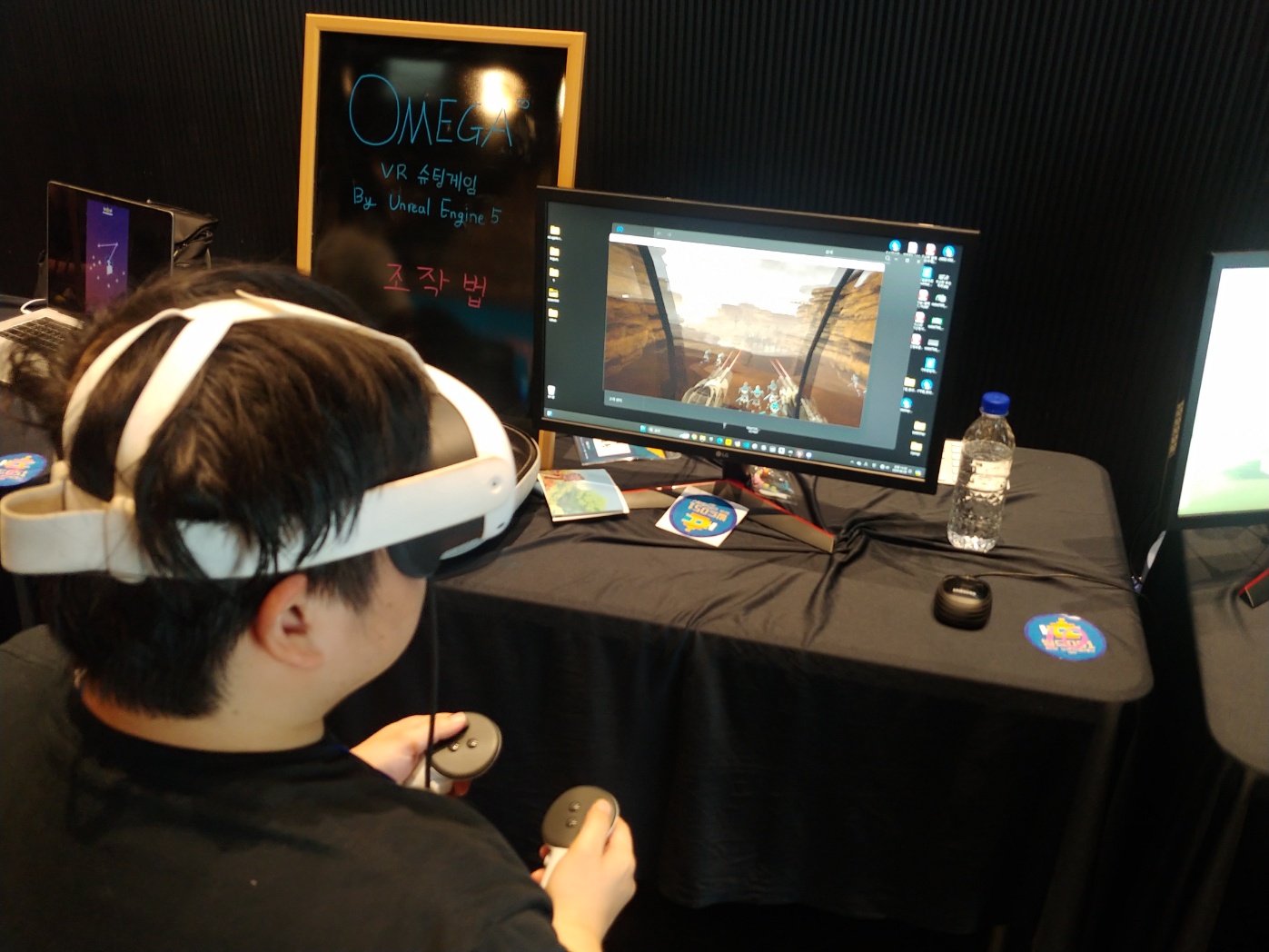
V: VR FPS Shooting Game
A scalable VR FPS framework built with UE5, leveraging design patterns and component-based architecture for enhanced maintainability.
Overview
This project is a VR FPS shooting game developed using Unreal Engine 5. Rather than simply implementing features, the focus was on adhering to Object-Oriented Programming (OOP) principles to reduce the coupling of complex combat systems. By actively utilizing Observer, Facade, and Component patterns, I established a stable damage system and AI decision-making structure capable of handling environments where dozens of allies and enemies coexist.
Tech Stack
| Category | Technologies |
|---|---|
| Game Engine | Unreal Engine 5 (UE5) |
| AI Architecture | Behavior Tree, AI Controller |
| Design Patterns | Observer, Facade, Component Pattern |
| Platform | Windows (VR Support) |
| Language | Blueprint |
Key Features
1. Pattern-Based Flexible Entity Management
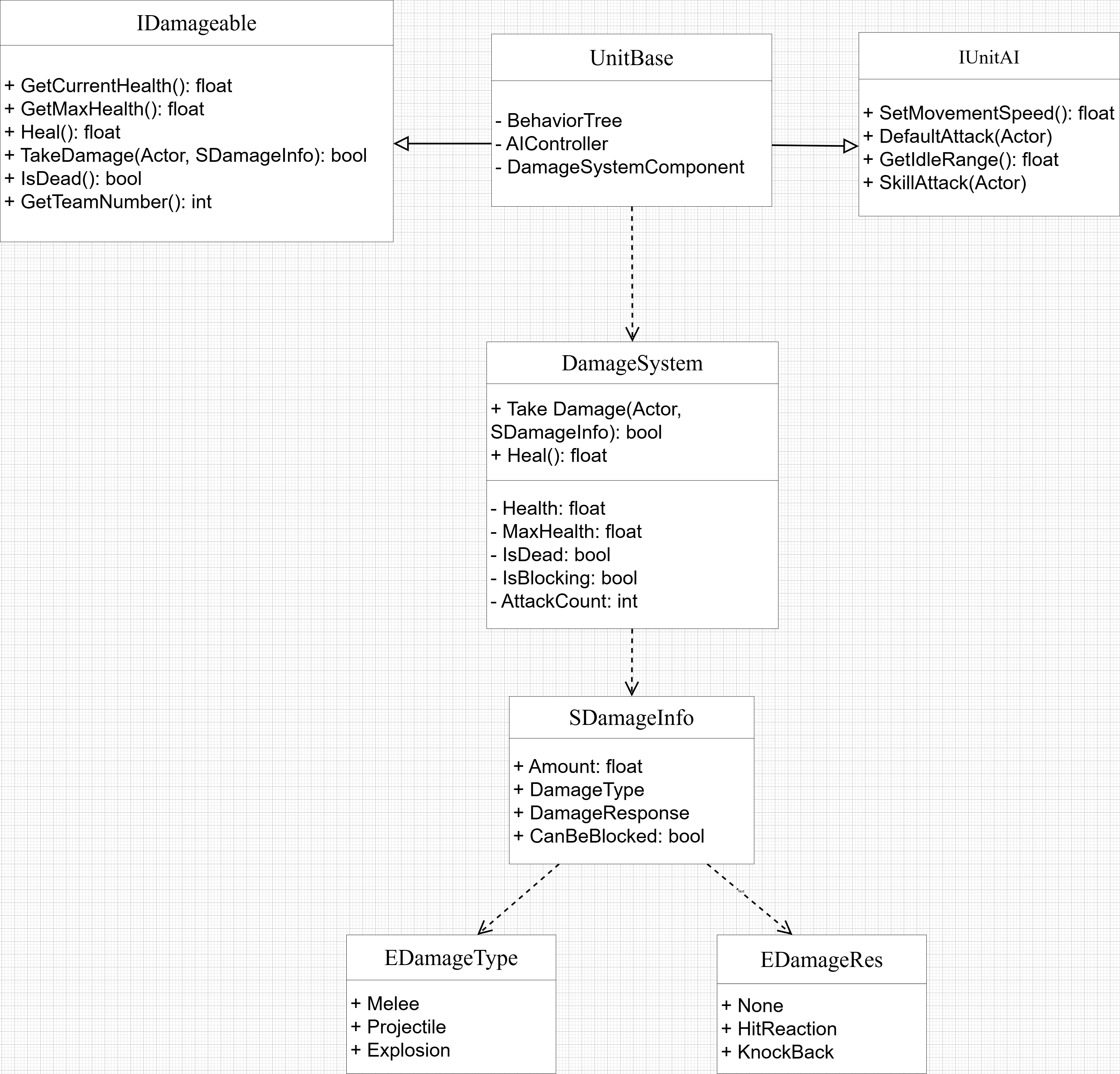
- Event-Driven Design via Observer Pattern: Handled health changes and death states without hard-coded references. When damage occurs, events are broadcasted to allow UI updates, animations, and sound effects to react independently.
- Interface Integration via Facade Pattern: Encapsulated complex internal logics such as attacking, health checks, and team identification into a single interface. This allows external systems to access data easily without knowing the detailed implementation of the entities.
2. Modular Component-Based Damage System
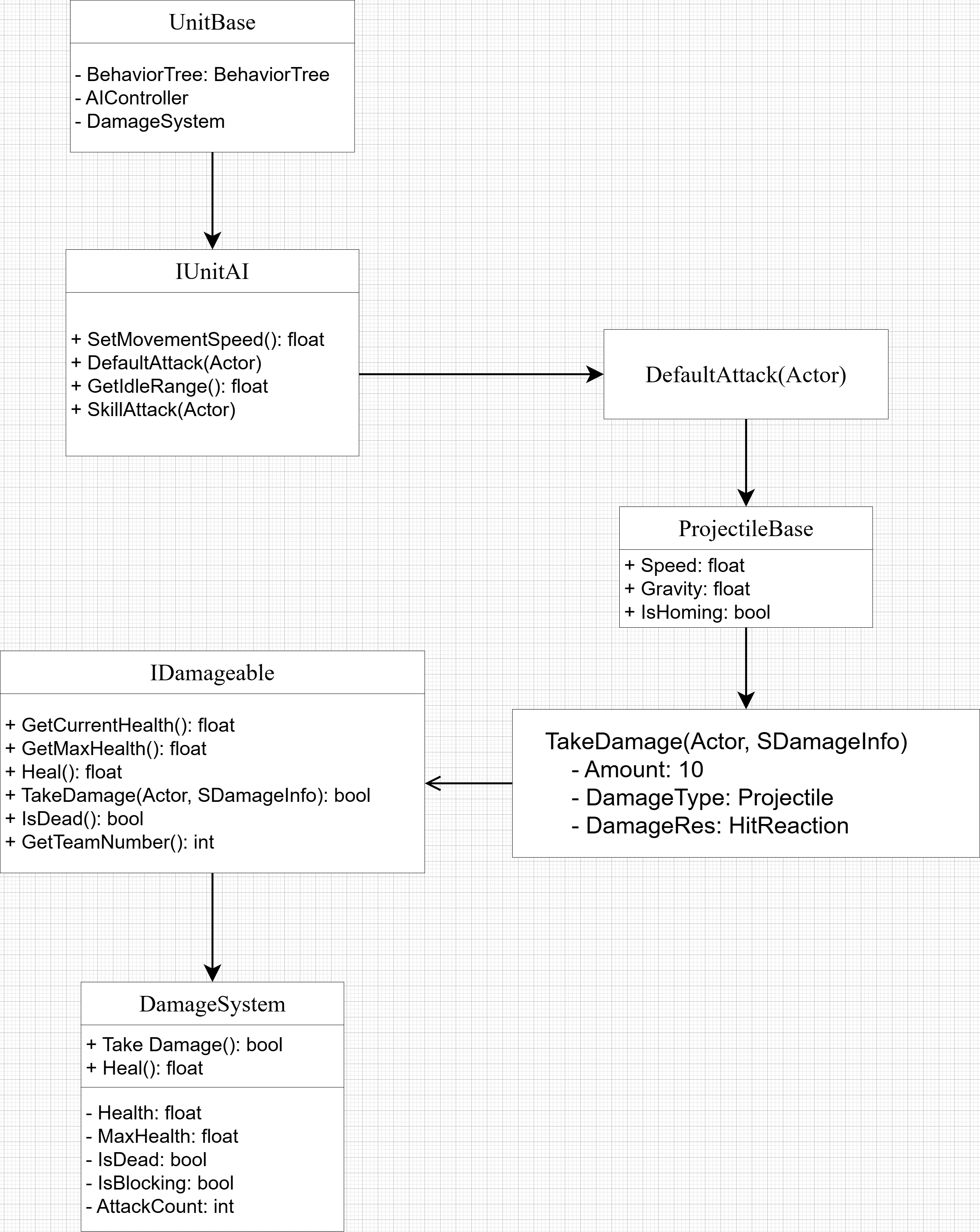
- Plug-and-Play Structure: Decoupled damage processing logic into independent components. This allows the damage system to be easily ported to any object—such as players, NPCs, or destructible structures—simply by attaching the component.
- Projectile-Based Collision Detection: Bound projectile collision events to calculate accurate hit points and called the
TakeDamagefunction to perform reliable physical calculations.
3. Hierarchical Behavior Tree AI
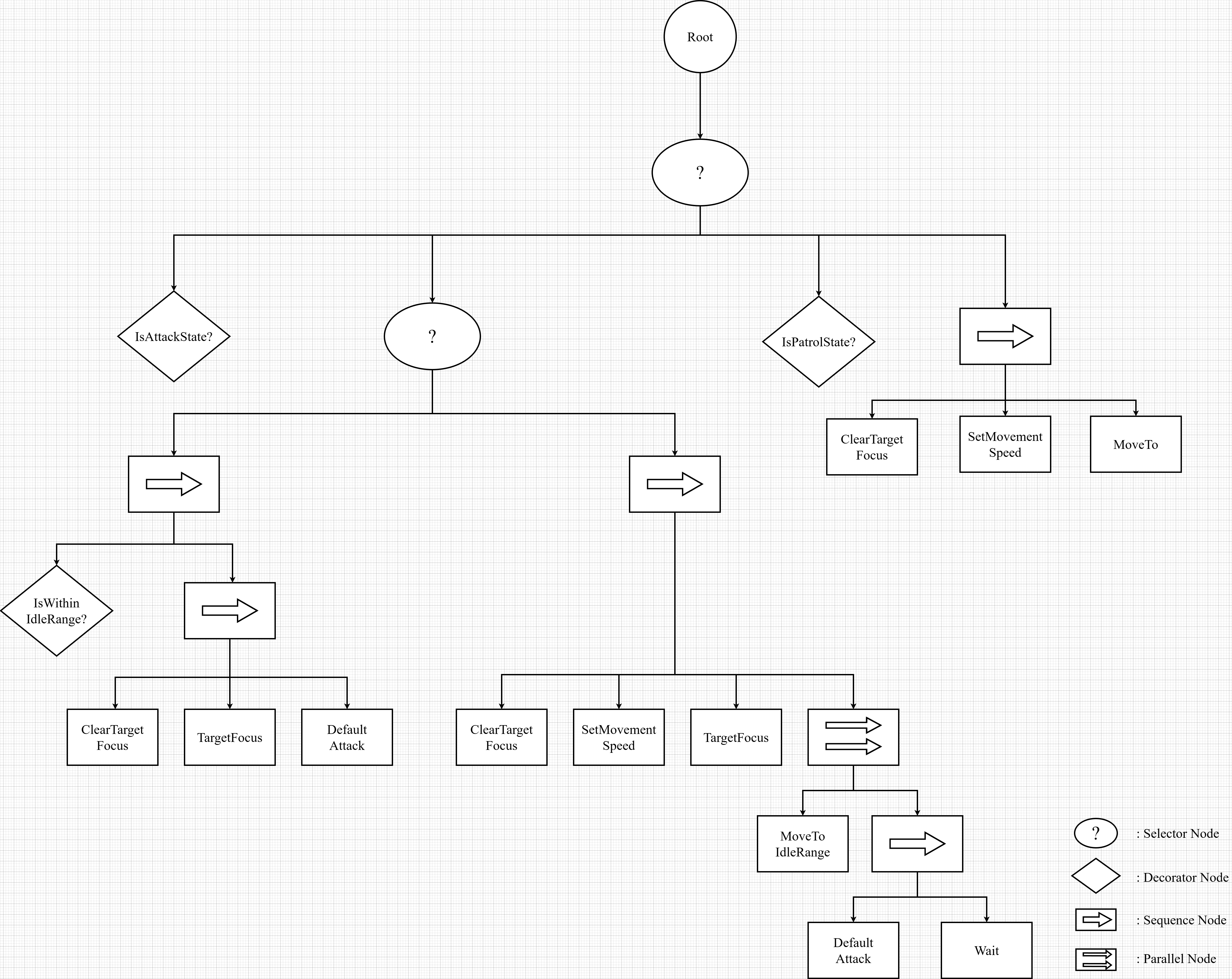
- Tactical Decision Making: Implemented decision-making logic for both allied and enemy AI using Behavior Trees (BT). Managed states hierarchically from target detection to range-based transitions.
- Dynamic Distance Control: Designed organic tactical behavior where AI approaches while firing if the target is beyond
IdleRange, and performs aiming and stationary fire once within range.
Technical Challenges & Solutions
1. Resolving Tight Coupling Between Objects
- Issue: Observed a phenomenon where modifying one unit’s code caused cascading errors due to strong dependencies.
- Solution: Introduced the Facade pattern to abstract core unit functions and utilized the Component pattern to build features modularly, removing direct dependencies between classes.
- Result: Secured high scalability, allowing the addition of new units or special features without modifying existing code.
2. Optimizing Large-Scale AI in VR
- Issue: Needed to prevent performance degradation caused by multiple NPCs executing Behavior Trees simultaneously.
- Solution: Optimized AI by adjusting the update cycles of sensing logic and managing AI Controller operations asynchronously. Implemented a distance-based tick system to differentiate update frequencies based on proximity to the player.
Results
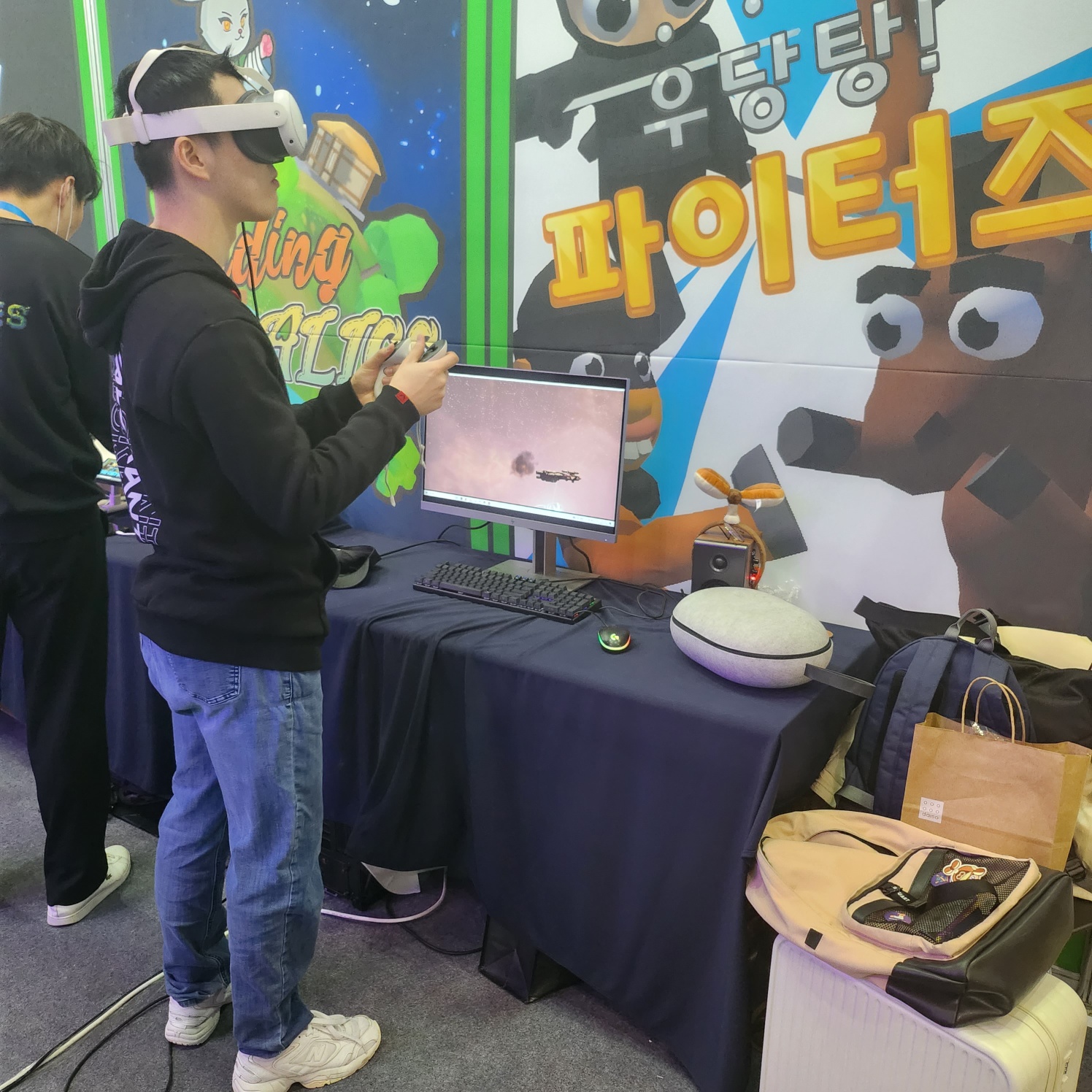
- Exhibited and demonstrated at the 2024 Busan-Gyeongnam Game Exhibition (Build 051).
- Exhibited and demonstrated at the 2023 G-STAR competition.